
This was inspired by a smaller Slack post I made to a leadership group I am part of, but I wanted to expand on it here.
The Setup: Where was I?
I had been working for OCAS as a Software Development Manager for about 3 years. When I started, I had 10 developers reporting to me from across 3 teams, eventually, I ended up with 10 developers from 4 teams reporting to me. The teams did not report to me, it was only the developers on the teams. The teams were a mix of full-stack, frontend and backend focus. Eventually, we restructured the teams and the EMs were embedded into the various teams. This resulted in me having 4 developers and 2 quality associates reporting to me. We had been in that structure for about 9 months when this all started.
Event: What Happened?
I was let go as part of a restructure in September 2025. That was all the context I was given. I had an amazing manager who reached out after to chat, so we met for coffee and he confirmed that it had nothing to do with anything I had been doing or not doing.
Action: The Job Hunt
This meant I needed to find a job. With the mandated compensation from OCAS, EI from the government and my wife still working, we would be okay for a bit of time, but I still felt the pressure to find something quickly to support my family.
I started by updating my existing resume and my LinkedIn profile. I am in Canada and I was going to be looking for local or remote work as an Engineering Manager or Senior Engineering Manager. I did not want to move or have a long commute due to family commitments.
During the initial month, I had been using the existing resume created with an online tool because that is what I had been using before, but I was finding no traction. I tried a few different versions of my resume, but nothing was working. They all produced the same results, or lack thereof. I ended up sharing my resume with a close friend who ran it through their company’s ATS and found that it didn’t pick up anything. This might have been the cause of so many rejections. Many companies use ATS systems to filter resumes before they even get to a human. It appeared the online tool had been making heavy use of tables to format things and when in PDF format, the ATS couldn’t read the tables.
With that information, I decided to rebuild my resume from the ground up. Using MS Word, I created a new resume with a simplified format that would be ATS-friendly. I focused on using lists of things instead of tables. Once I started using this new updated resume, I started getting responses.
Stats: All the numbers
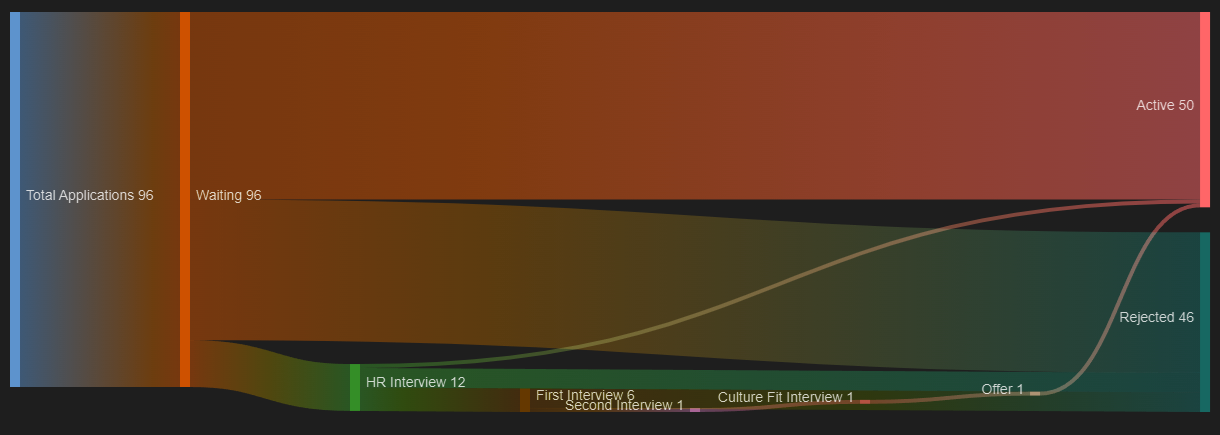
I ended up looking for work for 76 days. During that time, I submitted 96 job applications. From those applications, I got 12 first-round interviews, which is a 12% catch rate. At the highest level, over the course of 30 days, I ended up doing 17 interviews.
The Weirdness: Rejections and no responses
I experienced a lot of strange situations during my job search. Below are a few of them related to rejections and no responses.
- Many no responses beyond “our system sees you”
- A few places I interviewed once with and never heard from again
- Several that only let me know 60 days later, after the new person had already started, that they rejected me
- One place hired out for the recruiter who had no info about what the job actually was, so they were not able to answer any questions I had
- One place forgot they had already done a round 1 interview with me and tried to set it up again, only to set up a round 2 and never send me the invite. When they asked why I missed it and I said they never sent me an invite, then gave them new times, they never talked to me again
Feedback: Trying to improve
Most of the rejections were the standard “candidates that matched better or had stronger skills,” so I figured I would try to find out which skills were the deciding factor, so I could improve.
When trying to get feedback on ways to improve:
- No response
- They copy and paste the rejection back (still no actionable feedback)
- They reword the rejection and send it again (still no actionable feedback)
- Provide feedback about never managing managers in a professional setting (still no actionable feedback)
Without any actual feedback, I was left unsure where to focus my efforts for improvement. How do you get better without input? It helped drive home how important feedback is in a work setting.
Reflection: What I learned
This search was one of the hardest things I have done emotionally. Being faced with the challenge of starting from nothing, with your family depending on you, was hard. I created a journal where I wrote each day of the journey about whatever was on my mind. I included fun stickers on each page and tried to start each day with the journal as a way to keep consistency without the work framework. This helped me focus on progress each day by being able to reflect on what I had done and where I was going.
The recruiting, applying and hiring process is broken in many ways. There is a lack of transparency, feedback and communication. Many companies seem not to care about the candidate experience at all. I understand that companies have needs and requirements, but treating candidates with respect and dignity should be a given.
The Outcome: Where am I now?
The place I am starting in December is a great company that I really enjoyed interviewing with. They had a 5-step interview process, which felt long at the time but gave me a great view into the company and the team I would be working with. If I end up being a part of their interview process, I hope I can treat all candidates with the same respect and dignity that I wished I had received during my search.